|
About Haridwar
 The
sacred Himalayan
town of Haridwar
represents a living
lesson on Hinduism.
Located at the foot
of the Himalayas,
the town attracts
hordes of tourists
and devotees from
all corners of the
world. Haridwar also
holds significance
because it stands as
the gateway to the
chardham, which
includes Yamunotri,
Gangotri,
Badrinathji and
Kedarnathji.
Haridwar finds its
mention in the
ancient Hindu epics
and scriptures as 'Mayapuri',
Mokshadwar' and 'Gangadwar'.
Geographically, it
is at Haridwar where
the sacred Ganga
enters the northern
Indian plains.
During the Kumbh
Mela (held at the
interval of every 12
years), the
population of the
town swells up to
millions. The next
Kumbh Mela and the
Ardh Kumbh Mela
(held at every 6
years) are scheduled
to be held in
Haridwar in 2010.
Today, Haridwar is
seen as a mystic
centre for the
rejuvenation of the
body, mind and soul. The
sacred Himalayan
town of Haridwar
represents a living
lesson on Hinduism.
Located at the foot
of the Himalayas,
the town attracts
hordes of tourists
and devotees from
all corners of the
world. Haridwar also
holds significance
because it stands as
the gateway to the
chardham, which
includes Yamunotri,
Gangotri,
Badrinathji and
Kedarnathji.
Haridwar finds its
mention in the
ancient Hindu epics
and scriptures as 'Mayapuri',
Mokshadwar' and 'Gangadwar'.
Geographically, it
is at Haridwar where
the sacred Ganga
enters the northern
Indian plains.
During the Kumbh
Mela (held at the
interval of every 12
years), the
population of the
town swells up to
millions. The next
Kumbh Mela and the
Ardh Kumbh Mela
(held at every 6
years) are scheduled
to be held in
Haridwar in 2010.
Today, Haridwar is
seen as a mystic
centre for the
rejuvenation of the
body, mind and soul.
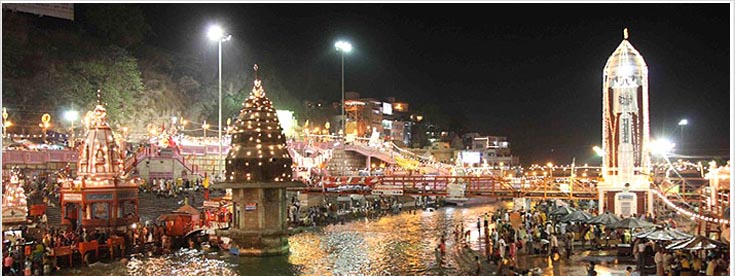
Har ki pauri:
Also known as Har ki
Pairi, it is the
centre of attraction
in the pilgrimage
town of Haridwar.
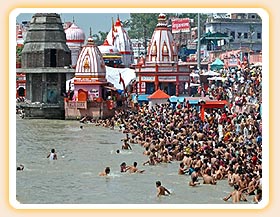 Devotees
gather here to take
a holy dip in the
Ganges and to offer
prayers. The
celebration Ganga
Aarti is
a sight to behold
here for tourists.
The aarti ceremony
takes place here
every evening at 7
pm. As the river
Ganga is worshipped,
hundreds of diyas
are set afloat along
the river. According
to Hindu mythology,
Har ki Pairiis the
place where a drop
of the nectar fell
from the moiling
oceans, when the
world came into
existence. Devotees
gather here to take
a holy dip in the
Ganges and to offer
prayers. The
celebration Ganga
Aarti is
a sight to behold
here for tourists.
The aarti ceremony
takes place here
every evening at 7
pm. As the river
Ganga is worshipped,
hundreds of diyas
are set afloat along
the river. According
to Hindu mythology,
Har ki Pairiis the
place where a drop
of the nectar fell
from the moiling
oceans, when the
world came into
existence.
Daksha Mahadev
Temple :
The temple is
situated towards the
south of the Kankhal
town. Built by Queen
Dhankaur in AD 1810,
the Daksha Mahadev
Temple is the site
where Daksha
performed a yagna (a
Hindu ritual to
invoke gods and seek
their blessings).
In the Hindu
mythology, Daksha
Prajapati is the
father of Sati, the
spouse of Lord
Shiva. The temple is
just a few minutes
drive from the
railway station.
Sapt Rishi :
The ashram is both
ancient and much
popular. The words
Sapt Rishi is a
combination of sapt
(seven) and rishi
(sage). According to
the Hindu
traditions, it is
the place where the
sacred Ganga split
herself in seven
streams to prevent
any disturbance to
the seven sages (Kashyapa,
Vashisht, Atri,
Vishwamitra,
Jamadagi, Bharadwaja
and Gautam) who were
deeply absorbed in
meditation. A 5 km
drive from Har ki
Pauri takes you to
the Sapt Rishi
Ashram.
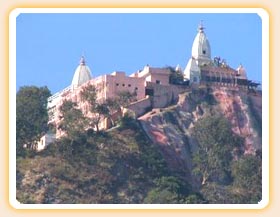 Mansa
Devi : Mansa
Devi :
One of the most
visited temples in
Haridwar, Mansa Devi
Mandir occupies a
place on top of the
Shivalik hills. The
temple is dedicated
to Goddess Mansa
Devi, believed to
fulfill the wishes
of those who visit
here. It is a
tradition with the
devotees to tie
sacred threads
around the tree that
stands within the
premises of the
Mansa Devi temple.
From the temple, one
can have heart
stirring views of
the Haridwar town.
Along with Chandi
Devi temple and the
Maya Devi temple, it
completes the
Siddhapeeth
Triangle.
Maya Devi :
Dedicated to goddess
Maya Devi, the
temple is a major
attraction for all
visitors to
Haridwar.
The temple is
counted as one of
the shaktipithas in
India. According to
the Hindu mythology,
it is the place
where the heart and
navel of goddess
Sati fell down,
while Lord Shiva was
carrying her burnt
body. Numerous
festivals are held
at the Maya Devi
temple in keeping
with the customs and
traditions.
Parad Shivling :
The mythological
 site
is located in the
historical town of
Kankhal, at 6 km
from the town
ofHaridwar. The
Parad Shivling
remains enshrined
inside the premises
of the Harihar
Ashram in Kankhal.
Weighing 150 kg, the
shivling is major
pilgrimage site for
Shaivites. Devotees
worship the shivling
to seek the
blessings of Lord
Shiva. site
is located in the
historical town of
Kankhal, at 6 km
from the town
ofHaridwar. The
Parad Shivling
remains enshrined
inside the premises
of the Harihar
Ashram in Kankhal.
Weighing 150 kg, the
shivling is major
pilgrimage site for
Shaivites. Devotees
worship the shivling
to seek the
blessings of Lord
Shiva.
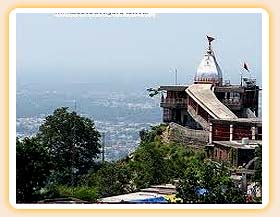
Chandi Devi :
The temple stands in
dedication to
Goddess Chandi. One
of the most ancient
in the country, the
temple can be
reached either by a
ropeway ride or by
undertaking a steep
climb, that takes up
around 45 minutes.
The rituals at the
temple begin as
early as 4 am in the
morning. Visitors
are required to
strictly follow the
dress code before
entering the
premises of the
Chandi Devi temple.
Bhimgoda Tank :
The tank is held in
high regard by the
whole Hindu
community. As per
the Hindu mythology,
the Bhimgoda Tank
was created when
Bhim, a legendary
character of the
Hindu epic
Mahabharata, hit his
knee against the
ground while the
Pandava brothers
were heading towards
the Himalayas. The
tank occupies a
position at a
distance of 300 m
from Har ki Pauri in
Haridwar.
|